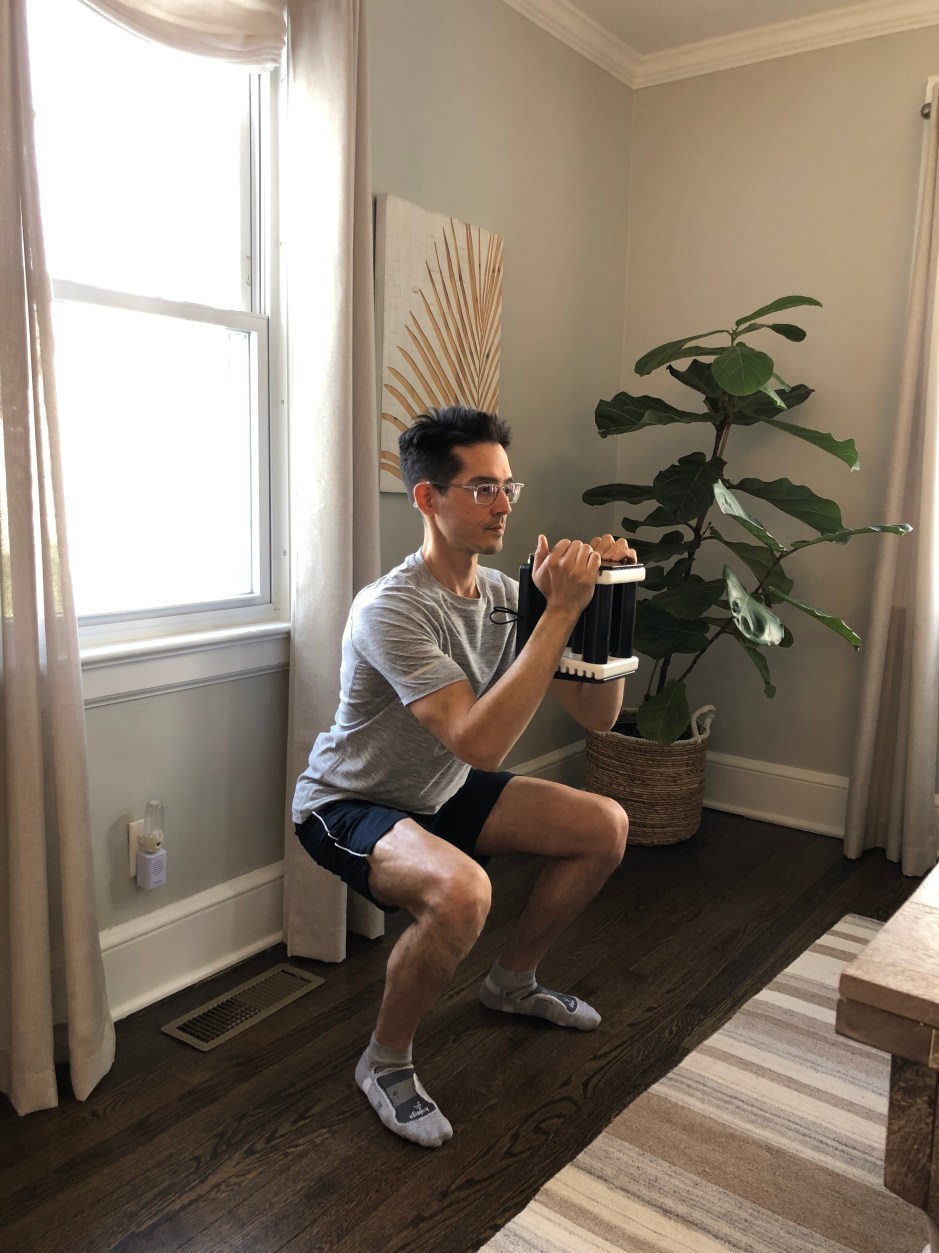
I like exercises that hit different muscle groups at once. More bang for your buck. Plus I feel that muscles were meant to work together to accomplish things, rather than just be bulked up in isolation. Squats are a great compound exercise that hit your quads, glutes and calves. For added difficulty and some shoulder and back activation, at the gym you would grab a dumbbell for extra weight and hold it like it you just found the holy grail, and call it a “goblet squat”. Honestly though, at home you can use a gallon of water or anything at all (even two smaller exercise weights together) for the added weight that you want. To perform the exercise, stand with feet shoulder width apart and toes pointed out slightly, weight grasped firmly with both hands and then lower into a squat keeping your back straight. To do this correctly, imagine that you are facing a wall and you are trying to sit onto a kiddie chair just behind you. You don’t lean forward because your face and knees will meet the wall. You don’t lean back too far or you fall backwards. It is almost a balancing act and you should feel all the weight going down through your heels. Once you are down as far as you can go, use your strength to stand up straight again. Again, all the force should drive through the heels. That’s one. Try to do eight of them, before taking a 1 minute break. Aim for 4 sets. Also, if you are wondering how far to squat down, I would say go until your thighs are parallel to the ground, but really squat down as deep as your flexibility and strength permit, noting that your tailbone (and thus your spine) should not curve under you at all and your strength should permit you to stand back up.
Category: Wednesday Workouts
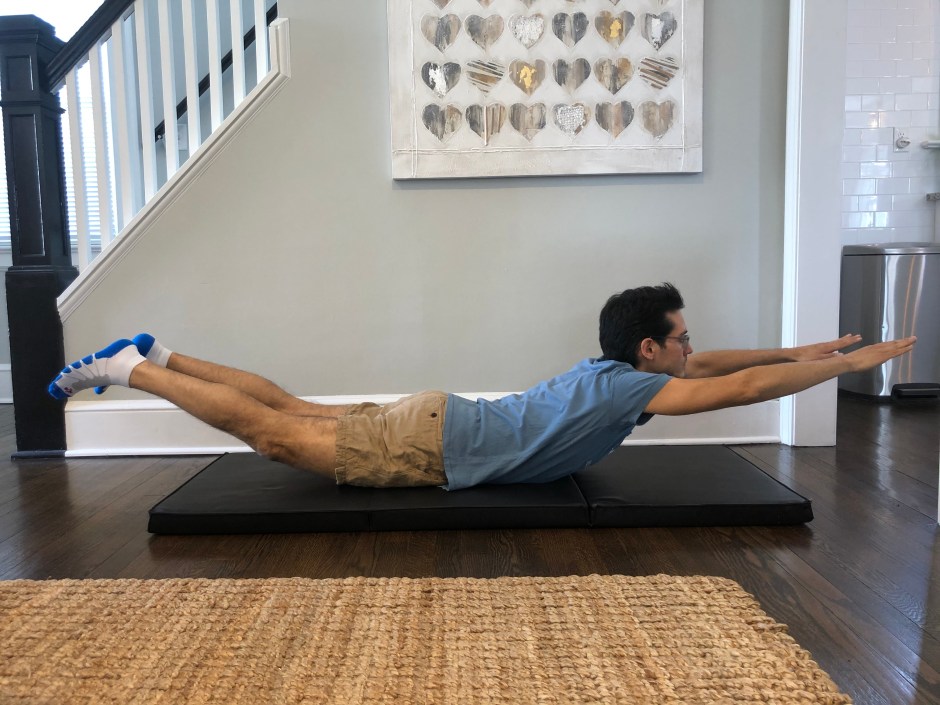
The superman exercise: a hero to your glutes, back and shoulders.
I think that a lot of people are overly focused on “pushing” movements (e.g. pushups and crunches) that workout the front of your body and they are not doing enough pulling movements that target the backside. The superman hits your glutes, hamstrings, upper and lower back and rear shoulders.
You begin by lying on your stomach with legs straight behind you and your arms in front palms down and shoulder width apart. Simultaneously lift your arms and your legs vertically and hold for a couple of seconds before lowering (see instructional video). That’s one. When lowering, don’t completely go all the way down. Rather, sustain the tension for the next one. Do 10 for one set. Rest for 30-60 seconds. Try to do 4 sets. Note that when you are raising your legs, the focus is less about lumbar spinal flexion and more about trying to make your glutes and hamstring do the work to lift your legs. The actual amount of lift won’t be a lot, but do your best to focus and activate those muscles.
“Instagram butt” or Anterior Pelvic Tilt?
Ever see someone do something and you say to yourself “that can’t be good right?” An easy example is a guy lifting a heavy thing, with bad posture, and doing a twisting motion. On instinct alone, you know it’s just not right. But what about something more subtle?
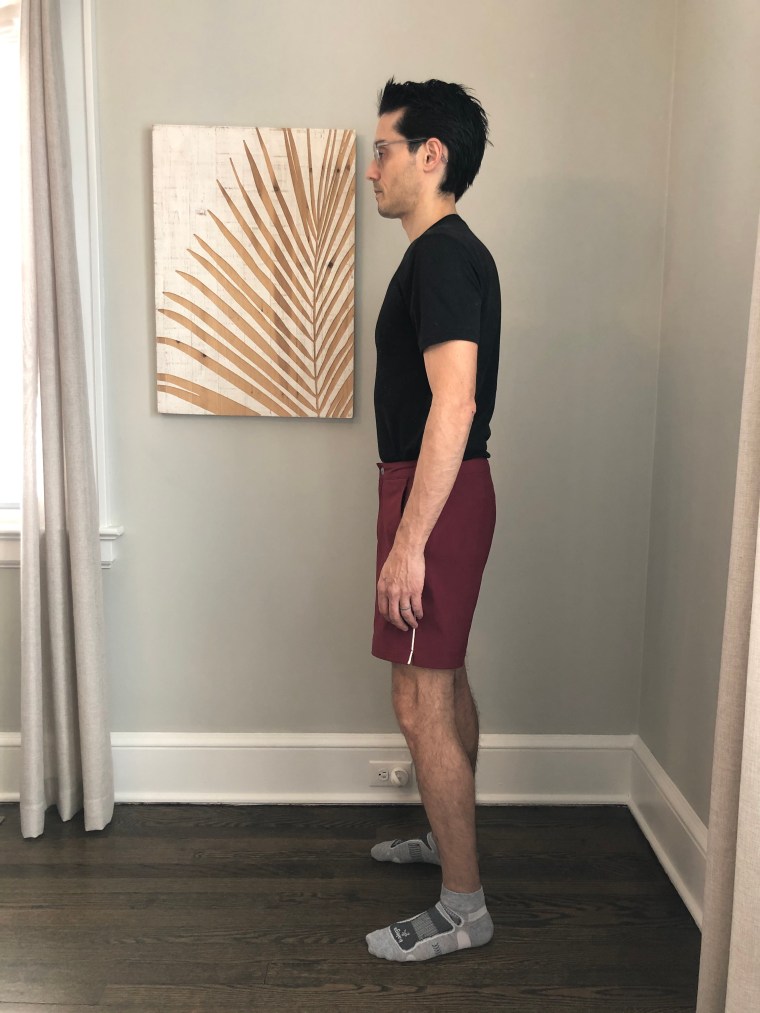
Ever see someone pose or walk with their booty with a little extra “pop”? Not sure if “Instagram butt” is a coined phrase, but that’s what I’m referring to here. Prized by many of the world’s Kim K followers, could the elevated derriere really be a Kracken, as yet unleashed? Let’s analyze: I read that our sedentary lifestyles can promote a posture that can make our glutes and abs weaker, while making other muscles tighter. The result is the Anterior Pelvic Tilt, where the front of your pelvis is rotated down, while the back of the pelvis is rotated up. Yes, it sounds exactly like what “Instagram butt” looks like. See the image showing regular posture compared to an exaggerated Anterior Pelvic Tilt posture. While an excessively curved spine might be the modern definition of “hot” (like the “good ole days” foot binding in Japan and the Victorian era faint-inducing corsets), the possible damage to your lumbar vertebrae might not be worth it. At best, sticking your booty out will do nothing. At worst, your lumbar vertebra will grind down and possibly require spinal fusion surgery to lock them in place.
I’m neither the fashion police, nor a doctor, but if you want a healthier spine (and better fitness while you’re at it), then there are a couple of exercises that can help you get your pelvis back into alignment: Glute Bridges will strengthen those butt muscles which will rotate the back of your pelvis down, while Dead Bugs will strengthen your abs and pull the front of your pelvis up. Please see the demonstrations of these exercises in our previous posts for guidance on doing them.
Happy Fitness everyone!

Regular Posture 
Exaggerated Anterior Pelvic Tilt Posture
Dead bugs can be fun…
No, this is not a childlike sense of wonder upon finding a pill bug. I am talking about a good core and ab exercise which is called the “Dead Bug” and it is kind of fun to do.
Lie back on a mat. Stretch your arms straight up to the sky and legs up with knees bent at 90 degrees. This is the starting position. Now extend your left arm above your head to get it parallel to the floor while straightening your right leg down to get it parallel to the floor. Then bring them back to the starting position. Now do the same for the right arm and left leg and together that’s one rep. Repeat that 12 times to make a set. Aim for 4 sets, taking 30 seconds to 1 minute rest between sets.
Glute Bridge, Single-Leg
Most people know the regular glute bridge, where you lie on your, back plant your heels with knees at 90 degrees, and thrust your hips up. While working out at home, I wanted something a little more difficult without having to find and put barbell plates on my hips. A more advanced version is the “Single Leg Glute Bridge”, where you keep one leg straight out and elevated and then use the other leg to perform the glute bridge alone. It’s harder because that one leg is doing all the work and is also carrying all the weight as you thrust your hips up. Try to hold each thrust for a couple of seconds. When you come back down on each rep, try to maintain muscle tension by not fully 100% coming down to the mat. Do 10 for each leg before taking a short 1-2 minute rest. That’s one set. Try to do 4 sets. See the video where I do a couple on each side for a quick demonstration of the movement. Also, it takes a little getting used to because isolating each leg does requires coordination and focus to make that mind-muscle connection. Before long you will be doing it perfectly and you’ll have stronger and more-toned glutes!
Let’s Get Moving!
This move is called a switch jump lunge. It is like a lunge, but with the added intensity of a jump. It’s a great lower body exercise that requires strength and coordination The starting position is a basic lunge, so place one leg back and place the other leg out front forming a 90 degree angle with your knee directly over your foot to get the form right. Now explosively jump and switch legs, landing again in a lunge and when you land. Don’t let your back knee touch the ground, because you want to sustain the tension and you don’t want to bang your knee on the ground either. Do 10 for each side, so 20 total per set. Rest for 30 seconds (or however long you need). Repeat. Try do do at least 4 sets. For a HIIT session try to do this for 15 minutes.
Good mornings.. the workout!
For a workout for your lower back as well as hamstrings and abs, try the “good morning.” Make sure you get the form right. Keep your back straight.

Start bending over and hinge at the hips, while keeping your back straight.

Continue bending until you are at a 90 degree angle and with your back parallel to the ground. Hold this position for around 5 seconds.

Keep good form as you engage your muscles to straighten up and complete the movement.
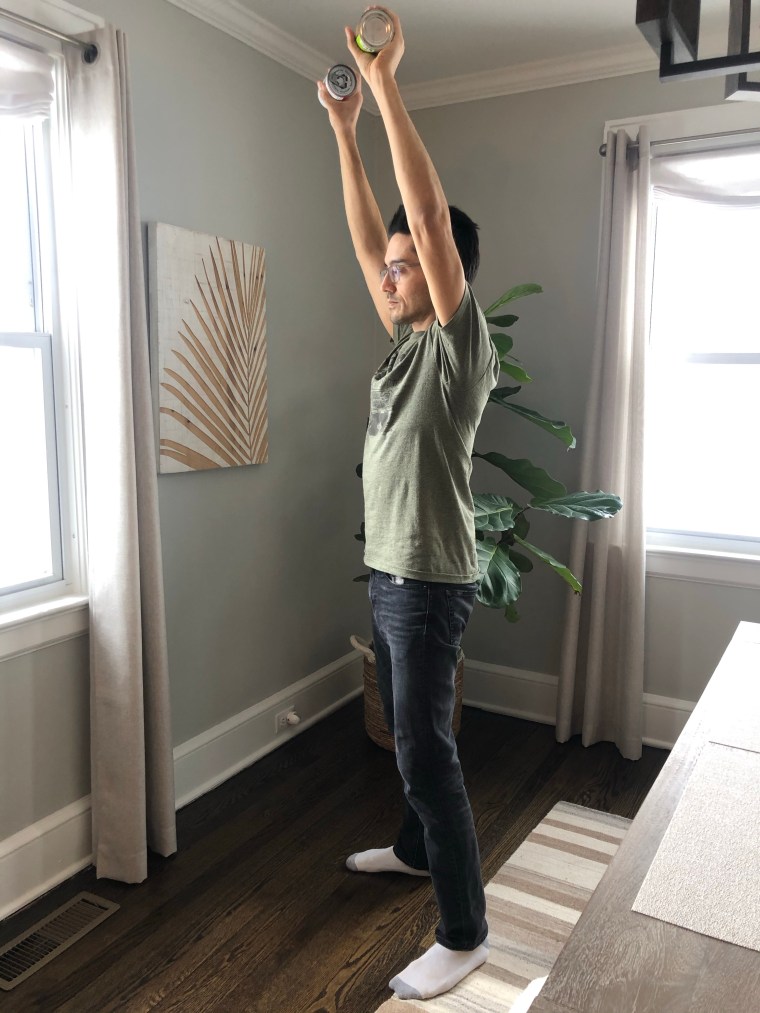
Try to do 4 sets of 15 repetitions. In the gym, people often use a barbell, but this exercise is easily modified for an at-home workout. You can keep you hands on your hips to make it easier as you bend, or have your arms outstretched or hold onto cans of food as weights to make it even more difficult.
Don’t forget to consult your doctor or trainer before changing your diet or workout routine.